- Study Abroad
- / ielts
- / the ozone hole reading answers
The Ozone Hole Reading Answers


Author
19-09-2025

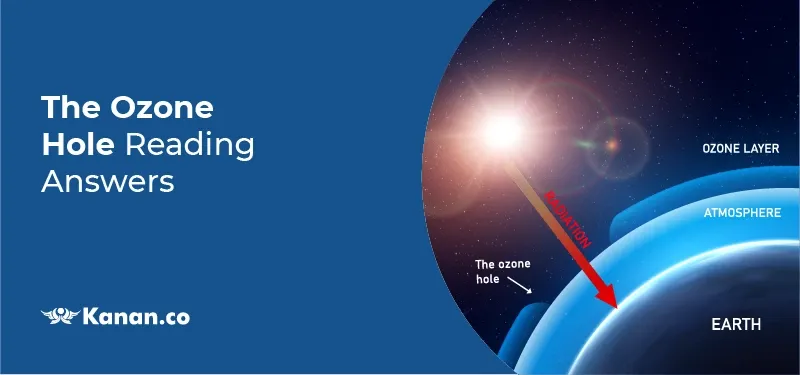
We have given The ozone hole reading answers, with explanations. It has 14 questions with three different question types- 6 questions in matching headings questions form, 6 questions in sentence completion questions form and 2 questions in diagram labeling questions form.
Table of contents:
- Solution for the ozone hole
- The ozone hole IELTS reading practice test.
- Passage.
- Questions
- Answers with explanations.
Solution for the ozone hole
Followed by, we have given the ozone hole reading answers, in table format.
Answer Table
| 14. vi | 18. i | 22. F | 26. D |
| 15. viii | 19. v | 23. A | 27. E |
| 16. ii | 20. H | 24. D | |
| 17. iv | 21. E | 25. B |

The Ozone Hole IELTS reading practice test - Exam Review
Check out our YouTube Channel to Practice Full-Length IELTS Reading Tests Daily

Examine the ozone hole IELTS reading answers to enhance your reading skills. Read the complete passage to answer the questions.
Passage
Check out the ozone hole reading answers with location which will help to answer your questions.
The ozone hole
Paragraph A
Ozone is a bluish gas that is harmful to breathe. Nearly 90% of the Earth's ozone is in the stratosphere and is referred to as the ozone layer. Ozone absorbs a band of ultraviolet radiation called UVB that is particularly harmful to living organisms. Stratospheric ozone is constantly being created and destroyed through natural cycles. Various ozone-depleting substances, however, accelerate the destruction processes, resulting in lower than normal ozone levels. Reductions in ozone levels will lead to higher levels of UVB reaching the Earth's surface. The sun's output of UVB does not change; rather, less ozone means less protection, and hence more UVB reaches the Earth. Studies have shown that in the Antarctic, the amount of UVB measured at the surface can double during the annual ozone hole. Laboratory and epidemiological studies demonstrate that UVB causes non-melanoma skin cancer and plays a major role in malignant melanoma development. In addition, UVB has been linked to cataracts.
Paragraph B
Dramatic loss of ozone in the lower stratosphere over Antarctica was first noticed in the 1970s by a research group from the British Antarctic Survey (BAS) who were monitoring the atmosphere above Antarctica from a research station. Folklore has it that when the first measurements were taken in 1975, the drop in ozone levels in the stratosphere was so dramatic that at first, the scientists thought their instruments were faulty. Replacement instruments were built and flown out and it wasn't until they confirmed the earlier measurements, several months later, that the ozone depletion observed was accepted as genuine. Another story goes that the BAS satellite data didn't show the dramatic loss of ozone because the software processing the raw ozone data from the satellite was programmed to treat very low values of ozone as bad readings. Later analysis of the raw data when the results from the British Antarctic Survey team were published, confirmed their results and showed that the loss was rapid and large-scale; over most of the Antarctica continent.
Paragraph C
Ozone occurs naturally in the atmosphere. The earth's atmosphere is composed of several layers. We live in the Troposphere, ground level up to about 10km high, where most of the weather occurs such as rain, snow, and clouds. Above that is the Stratosphere, an important region in which effects such as the Ozone Hole and Global Warming originate. The layer next to space is the Exosphere and then going inwards there are the Thermosphere and the Mesosphere. Supersonic passenger jets fly just above the troposphere whereas subsonic commercial airliners are usually well in the troposphere. The narrow region between these two parts of the atmosphere is called the Tropopause. Ozone forms a layer in the stratosphere, thinnest in the tropics and denser towards the poles. The amount of ozone above a point on the earth's surface is measured in Dobson units (DU) - typically ~260 DU near the tropics and higher elsewhere, though there are large seasonal fluctuations. It is created when ultraviolet radiation in the form of sunlight strikes the stratosphere, splitting oxygen molecules into atomic oxygen. The atomic oxygen quickly combines with further oxygen molecules to form ozone.
Paragraph D
The Ozone Hole often gets confused in the popular press and by the general public with the problem of global warming. Whilst there is a connection because ozone contributes to the greenhouse effect, the Ozone Hole is a separate issue. Over Antarctica (and recently over the Arctic), stratospheric ozone has been depleted over the last 15 years at certain times of the year. This is mainly due to the release of man-made chemicals containing chlorine such as CFCs (ChloroFluorocarbons) but also compounds containing bromine, other related halogen compounds, and also nitrogen oxides. CFCs are a common industrial product, used in refrigeration systems, air conditioners, aerosols, solvents, and in the production of some types of packaging. Nitrogen oxides are a by-product of combustion processes, for example, aircraft emissions.
Paragraph E
The ozone depletion process begins when CFCs and other ozone-depleting substances are emitted into the atmosphere where winds efficiently mix and evenly distribute the gases. CFCs are extremely stable, and they do not dissolve in rain. After several years, natural gases in the stratosphere combine with CFCs and this releases chlorine atoms, halons, and methyl bromide. These in turn all release bromine atoms and it is these atoms that destroy ozone. It is estimated that one chlorine atom can destroy over 100,000 ozone molecules before it is removed from the stratosphere.
Paragraph F
The first global agreement to restrict CFCs came with the signing of the Montreal Protocol in 1987 ultimately aiming to reduce them by half by the year 2000. Two revisions of this agreement have been made in the light of advances in scientific understanding, the latest being in 1992. An agreement has been reached on the control of industrial production of many halocarbons until the year 2030. The main CFCs will not be produced by any of the signatories after the end of 1995, except for a limited amount for essential uses, such as medical sprays. The countries of the European Community have adopted even stricter measures. Recognizing their responsibility to the global environment they have agreed to halt production of the main CFCs from the beginning of 1995. It was anticipated that these limitations would lead to a recovery of the ozone layer within 50 years of 2000. The World Meteorological Organisation estimated 2045 but recent investigations suggest the problem is perhaps on a much larger scale than anticipated.
Questions
Questions 14-19
- The reading passage on The Ozone Hole has 6 paragraphs (A-F)
- From the list of headings below (i-ix) choose the most suitable headings for paragraphs A-F.
- Write the appropriate number (i-ix) in boxes 14-19 on your answer sheet.
i –The Destruction Process
ii –How Is Ozone Formed?
iii– How Technology Can Help
iv –Artificial Emissions
v –What Is Being Done?
vi –The Function of the Ozone Layer
vii– Empirical Analysis
viii– Initial Identification
ix –Hospitalization
14. Paragraph A
15. Paragraph B
16. Paragraph C
17. Paragraph D
18. Paragraph E
19. Paragraph F
Questions 20-25
- Complete the following statements (questions 20-25) with the best ending from the box below (A-H) according to the information in the reading passage The Ozone Hole.
- Write the appropriate letter (A-H) on your answer sheet.
- There are more sentence endings (A – H) than questions so you will not need to use
- them all.
20. International agreements will eventually lead to…
21. An apocryphal BAS story cites that equipment was changed to measure…
22. It is a common mistake to associate the Ozone Hole problem with…
23. The thickness of the Ozone layer varies with…
24. The Ozone layer is destroyed by a by-product of CFCs reacting with…
25. Common household appliances contribute to…
A …the location of the layer relative to the earth.
B …the discharge of synthetic chemicals into the atmosphere.
C…the satellite orbiting the earth.
D …the normal components of the earth’s atmosphere.
E …the anomalous readings taken earlier.
F…the issue of the heating up of the earth’s atmosphere.
G…recent investigations into the strength of Dobson Units.
H …the cessation of the release of most CFC gasses into the atmosphere.
Questions 26 and 27
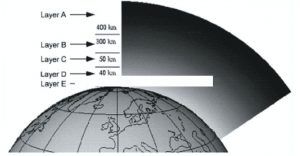
- Answer questions 26-27 below regarding the diagram of the earth and its layers of the atmosphere at the bottom of the page
- Write the appropriate letter (A-E) on your answer sheet.
26. In which atmosphere layer would you find the Ozone layer and hole?
27. In which atmosphere layer would you find a conventional passenger airliner usually flying?
Answers for the Ozone Hole with explanation
We have given the Ozone Hole Reading Answers with explanations, go through it to correct your errors.
(Note: The text in italics mentions the location and referring lines written in the reading passage)
14. Answer: vi
Explanation: Ozone is a bluish gas that is harmful to breathe. Nearly 90% of the Earth’s ozone is in the stratosphere and is referred to as the ozone layer. Ozone absorbs a band of ultraviolet radiation called UVB that is particularly harmful to living organisms. Stratospheric ozone is constantly being created and destroyed through natural cycles. Various ozone-depleting substances, however, accelerate the destruction processes, resulting in lower than normal ozone levels. Reductions in ozone levels will lead to higher levels of UVB reaching the Earth’s surface.The given answer is located in the 1-7 lines of paragraph A.
15. Answer: viii
Explanation: “Dramatic loss of ozone in the lower stratosphere over Antarctica was first noticed in the 1970s by a research group from the British Antarctic Survey (BAS) who were monitoring the atmosphere above Antarctica from a research station. Folklore has it that when the first measurements were taken in 1975, the drop in ozone levels in the stratosphere was so dramatic that at first, the scientists thought their instruments were faulty. Replacement instruments were built and flown out and it wasn’t until they confirmed the earlier measurements, several months later, that the ozone depletion observed was accepted as genuine.” The given answer is located in the 1-8 lines of paragraph B.
16. Answer: ii
Explanation: Ozone forms a layer in the stratosphere, thinnest in the tropics, and denser towards the poles. The amount of ozone above a point on the earth’s surface is measured in Dobson units (DU) – typically ~260 DU near the tropics and higher elsewhere, though there are large seasonal fluctuations. It is created when ultraviolet radiation in the form of sunlight strikes the stratosphere, splitting oxygen molecules into atomic oxygen. The atomic oxygen quickly combines with further oxygen molecules to form ozone. The given answer is located in the last 6 lines of paragraph C.
17. Answer: iv
Explanation: Antarctica (and recently over the Arctic), stratospheric ozone has been depleted over the last 15 years at certain times of the year. This is mainly due to the release of man-made chemicals containing chlorine such as CFCs (ChloroFluoroCarbons) but also compounds containing bromine, other related halogen compounds, and also nitrogen oxides. CFCs are a common industrial product, used in refrigeration systems, air conditioners, aerosols, solvents, and in the production of some types of packaging. Nitrogen oxides are a by-product of combustion processes, for example, aircraft emissions. The given answer is located in the last 8 lines of paragraph D.
18. Answer: i
Explanation: when CFCs and other ozone-depleting substances are emitted into the atmosphere where winds efficiently mix and evenly distribute the gases. CFCs are extremely stable, and they do not dissolve in rain. After several years, natural gases in the stratosphere combine with CFCs and this releases chlorine atoms, halons, and methyl bromide. These in turn all release bromine atoms and it is these atoms that destroy ozone. The given answer is located in the 1-6 lines of paragraph E.
19. Answer: v
Explanation: Global environment they have agreed to halt production of the main CFCs from the beginning of 1995. It was anticipated that these limitations would lead to a recovery of the ozone layer within 50 years of 2000. The World Meteorological Organisation estimated 2045 but recent investigations suggest the problem is perhaps on a much larger scale than anticipated. The given answer is located in the last 5 lines of paragraph F.
20. Answer: H
Explanation: First global agreement to restrict CFCs came with the signing of the Montreal Protocol in 1987 ultimately aiming to reduce them by half by the year 2000. Two revisions of this agreement have been made in the light of advances in scientific understanding, the latest being in 1992. The given answer is located in the 1-4 lines of paragraph F.
21. Answer: E
Explanation: BAS was monitoring the atmosphere above Antarctica from a research station. Folklore has it that when the first measurements were taken in 1975, the drop in ozone levels in the stratosphere was so dramatic that at first, the scientists thought their instruments were faulty. Replacement instruments were built and flown out and it wasn’t until they confirmed the earlier measurements, several months later, The given answer is located in the 2-7 lines of paragraph B.
22. Answer: F
Explanation: Ozone occurs naturally in the atmosphere, which is composed of several layers. In the 4th line, it is mentioned that above that is the Stratosphere, an important region in which effects such as the Ozone Hole and Global Warming originate. The given answer is located in the 1-5 lines of paragraph C.
23. Answer: A
Explanation: Ozone forms a layer in the stratosphere, thinnest in the tropics, and denser towards the poles. The given answer is located in the 9-10 lines of paragraph C.
24. Answer: D
Explanation: The ozone depletion process begins when CFCs and other ozone-depleting substances are emitted into the atmosphere where winds efficiently mix and evenly distribute the gases. The given answer is located in the 1-3 lines of paragraph E.
25. Answer: B
Explanation: This is mainly due to the release of man-made chemicals containing chlorine such as CFCs (ChloroFluoroCarbons) but also compounds containing bromine, other related halogen compounds, and also nitrogen oxides. CFCs are a common industrial product, used in refrigeration systems, air conditioners, aerosols, solvents, and in the production of some types of packaging. The given answer is located in the 5-9 lines of paragraph D.
26. Answer: D
Explanation: Ozone occurs naturally in the atmosphere. The earth’s atmosphere is composed of several layers. We live in the Troposphere, ground level up to about 10 km high, where most of the weather occurs such as rain, snow, and clouds. Above that is the Stratosphere, an important region in which effects such as the Ozone Hole and Global Warming originate. The given answer is located in the first 5 lines of paragraph C.
27. Answer: E
Explanation: Supersonic passenger jets fly just above the troposphere whereas subsonic commercial airliners are usually well in the troposphere. The narrow region between these two parts of the atmosphere is called the Tropopause. The given answer is located in the 6-9 lines of paragraph C.
Other reading answers

About Author Gayathri Nagarajan
Gayathri, a trusted study-abroad expert, with expertise in standardized tests like IELTS, TOEFL, PTE, GRE, and GMAT. With a strong tech background from SASTRA University, she excels in software testing and has a passion for content writing and digital marketing. She aids students in finding the perfect academic fit, offering guidance on course selection, LOR and SOP writing. She remains up-to-date with the latest trends in higher education, delivering credible, accurate information on international education, including courses and test prep materials. As a trusted Study abroad expert at Kanan International, explore her latest blogs and articles for comprehensive insights into studying abroad and realizing your academic aspirations.
Kanan.co is a trusted study abroad consultancy offering comprehensive services, resources, and solutions for students and education institutions. We support students at every stage of their global education journey, ensuring a smooth and guided experience. Along with test preparation for IELTS, GRE, TOEFL, and SAT, we provide expert services such as SOP writing, visa guidance, accommodation support, scholarship assistance, and education loan support. Our expertise and commitment to excellence make us a reliable partner for students pursuing international education.
Free Online Mock Test 2026
Practice our mock test worth Rs. 25000 for Free and know your IELTS score!








Global Headquarters
Kanan Int EdTech Inc
320 Bay Street, Suite 321 (Spaces), Toronto ON, Canada M5B 1N9
Indian Headquarters
Kanan International Pvt. Ltd.
D-wing, 2nd Floor, Trident Complex, Ellora Park Vadiwadi Road, Vadodara, Gujarat 390007
IT/ Digital Campus
Kanan International Pvt. Ltd
Old, New No 3, 2nd Floor, 1A, Dr Sadasivam Rd, T. Nagar, Chennai, Tamil Nadu 600017
Our branches
- Bardoli
- Bharuch
- Chennai
- Dehradun
- Gurugram
- Himatnagar
- Karnal
- Nadiad
- Navsari
- Palanpur
- Rajkot
- Vadodara
- Valsad
- Vallabh Vidyanagar
- Vapi
Study Abroad
Test Prep
Top Universities
Consultants
IELTS Centers
GRE Centers
TOEFL Centers
SAT Centers
Language Courses in Vadodara
SOP Blogs
Featured Blogs
Study Abroad Consultants in Chennai
Study Abroad Consultants in Surat
Study Abroad Consultants in Navsari
Study Abroad Consultants in Bardoli
Study Abroad Consultants in Ahmedabad
Study Abroad Consultants in Anand
Study Abroad Consultants in Khanna
Study Abroad Consultants in Nadiad
Study Abroad Consultants in Vadodara
Study abroad consultants in Valsad
Copyright © 2026 KANAN.CO All rights reserved.